GGHK-Cu skincare has attracted increasing attention because of the peptide’s relationship with processes involved in the skin’s extracellular matrix, including collagen, elastin and glycosaminoglycans.
That sounds impressive, but it needs some context.
Much of what scientists know about GHK-Cu comes from laboratory and biological research. Translating those findings into what someone can realistically expect from a topical serum or cream is more complicated.
So what might GHK-Cu actually do for the appearance of your skin?
What does GHK-Cu do in the skin?
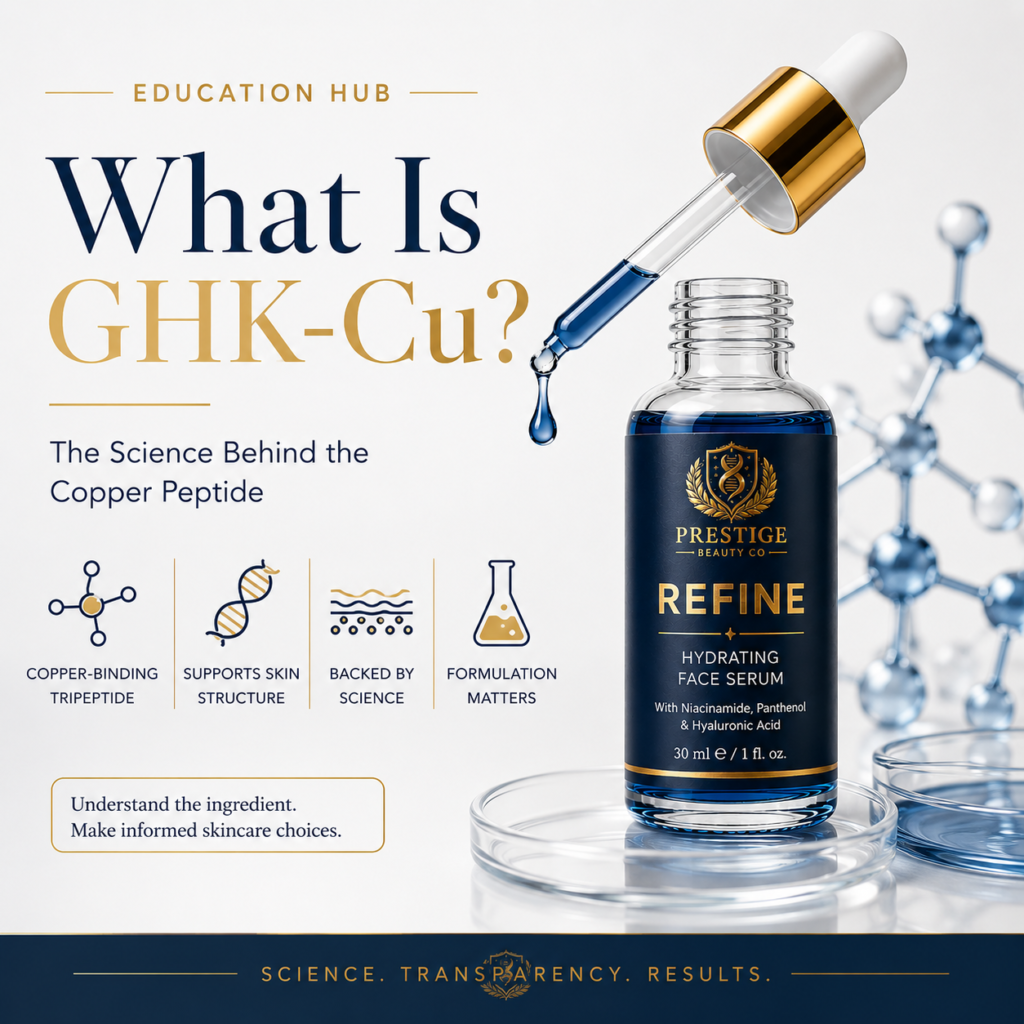
GHK-Cu is a copper-binding tripeptide composed of glycine, histidine and lysine.
If you’re new to the ingredient, our guide What Is GHK-Cu? explains its structure and background in more detail.
For skincare, much of the interest centres on the extracellular matrix. This is the structural environment surrounding skin cells and includes components such as collagen, elastin and glycosaminoglycans.
Laboratory research has associated GHK and GHK-Cu with fibroblast activity and processes involved in the production and regulation of these components.
This gives researchers a biological reason to investigate GHK-Cu for visible characteristics associated with skin ageing.
It does not, however, mean that applying a GHK-Cu cosmetic automatically recreates every effect observed in laboratory experiments.
Can GHK-Cu help the appearance of fine lines and wrinkles?
This is probably the reason most people discover copper peptide skincare.
Published literature describes GHK-Cu as having activity relevant to collagen and other components of the extracellular matrix, providing a plausible mechanism for investigating its effect on the appearance of ageing skin.
Reviews of earlier cosmetic research have reported improvements in characteristics including fine lines and wrinkles after topical use.
However, the human evidence specifically for GHK-Cu is much smaller than the enormous number of claims made about it online might suggest.
A recent review of topical GHK and its derivatives highlighted the limited clinical evidence available and called for further investigation into effectiveness, permeability and formulation.
So it is reasonable to regard the appearance of fine lines as an area of interest for GHK-Cu skincare.
It is not reasonable to promise that a GHK-Cu cosmetic will erase wrinkles.
What about firmness and elasticity?
Collagen and elastin contribute to the structural properties of skin, which explains why GHK-Cu research involving these components has attracted attention within cosmetic science.
Earlier research summarised in scientific reviews has associated topical copper peptide use with improvements in measurements or assessments relating to skin firmness, elasticity and density.
These findings are encouraging.
But again, there is an important difference between evidence suggesting potential and evidence demonstrating that every finished cosmetic containing GHK-Cu will produce a particular result.
The formulation matters.
So do the concentration, stability of the peptide, delivery system, other ingredients and how consistently the product is used.
Can GHK-Cu improve skin texture?
Texture is influenced by many things, including hydration, the condition of the skin barrier, surface irregularities and age-related changes within the skin.
Research surrounding GHK-Cu and extracellular matrix components gives the ingredient a plausible role in formulations designed to improve the overall appearance and condition of skin.
Someone using a well-formulated peptide product may therefore be interested in improvements such as skin feeling smoother or appearing more refined.
But “skin texture” is a broad cosmetic description rather than a single biological measurement.
That is why we would avoid presenting GHK-Cu as a guaranteed solution for every texture concern.
What about hydration?
GHK has been associated in experimental research with processes involving glycosaminoglycans and proteoglycans, which form part of the extracellular environment of the skin.
That makes hydration an interesting part of the wider GHK-Cu story.
But the immediate moisturising effect someone experiences from a serum is also heavily influenced by the rest of its formulation.
Humectants and other hydrating ingredients can contribute considerably to how hydrated, soft and comfortable the skin feels.
This is an important distinction when evaluating peptide skincare.
Not every benefit experienced from a GHK-Cu serum necessarily comes from GHK-Cu alone.
Does GHK-Cu improve skin tone?
This is an area where online claims can quickly become exaggerated.
Some literature surrounding GHK-Cu discusses changes in the overall appearance of ageing or photodamaged skin, and older reviews describe observations involving pigmentation.
That does not make GHK-Cu an established treatment for pigmentation disorders.
If uneven tone is someone’s primary concern, it is better to evaluate the evidence for ingredients specifically studied for that purpose rather than assuming every biological action associated with GHK-Cu translates into a visible pigmentation benefit.
For Prestige, the more defensible position is to consider GHK-Cu as part of a broader formula concerned with the appearance and condition of skin.
What can’t GHK-Cu promise?
GHK-Cu is an interesting ingredient.
It isn’t magic.
A cosmetic containing GHK-Cu should not be expected to:
- eliminate wrinkles
- permanently reverse skin ageing
- rebuild damaged skin overnight
- reproduce every effect observed in cell or laboratory research
- guarantee the same results for every person
This distinction matters because GHK-Cu has become associated online with claims extending far beyond ordinary cosmetic skincare.
Interesting biological research should not be converted automatically into promises about a bottle of serum.
Does GHK-Cu actually penetrate the skin?
This is one of the most interesting questions surrounding topical peptides.
For an ingredient to influence a biological target within the skin, enough of it needs to reach the appropriate location.
The outermost layer of skin, the stratum corneum, is an effective barrier, and hydrophilic peptides can present particular delivery challenges.
GHK-Cu appears to have better permeability characteristics than uncomplexed GHK in some experimental models, but the available research is still limited.
A recent scientific review specifically identified skin permeability as an area where considerably more investigation is needed. Research using skin models has also shown that the amount reaching different layers can vary substantially.
This is one reason why judging a GHK-Cu product purely by the percentage on its label can be misleading.
Does a higher percentage of GHK-Cu work better?
Not necessarily.
It is tempting to compare peptide skincare by looking for the largest concentration.
But concentration is only one part of formulation.
A formulator also has to consider:
- peptide stability
- pH
- compatibility with other ingredients
- the product vehicle
- preservation
- skin tolerance
- delivery and availability of the ingredient
Peptides can be particularly challenging because their physicochemical characteristics affect both stability and skin permeation.
A higher number therefore does not automatically mean a better finished product.
How long does GHK-Cu take to work?
There isn’t a scientifically defensible universal answer.
Skin appearance does not change on a fixed timetable, and different formulations cannot be assumed to perform identically simply because they contain the same headline ingredient.
Some older cosmetic research discussed in reviews assessed topical copper peptide use over periods of several weeks or months rather than days.
That is a much more realistic way to think about peptide skincare.
Immediate changes in how skin feels may come from the hydrating and conditioning components of a formulation.
Changes involving the visible appearance of skin should generally be judged through consistent use over time.
Be suspicious of promises of dramatic transformation within a few days.
GHK-Cu serum or cream?
Neither format is automatically superior.
A serum provides a lightweight way of incorporating GHK-Cu into a routine and can combine the peptide with complementary hydrating ingredients.
A cream provides a richer vehicle and may combine peptide skincare with moisturising and barrier-supporting ingredients.
The choice therefore depends partly on the formulation and partly on what role you want the product to play within your routine.
For someone building a layered routine, a GHK-Cu serum can sit before moisturiser.
For someone who prefers fewer steps, a peptide-containing cream may make more sense.
We’ll explore this properly in our separate guide to Serum vs Cream: Where Do Peptides Fit?
You can also read How to Use GHK-Cu in Your Skincare Routine for a practical look at where copper peptide products can fit into a daily routine.
Where does REFINE fit?
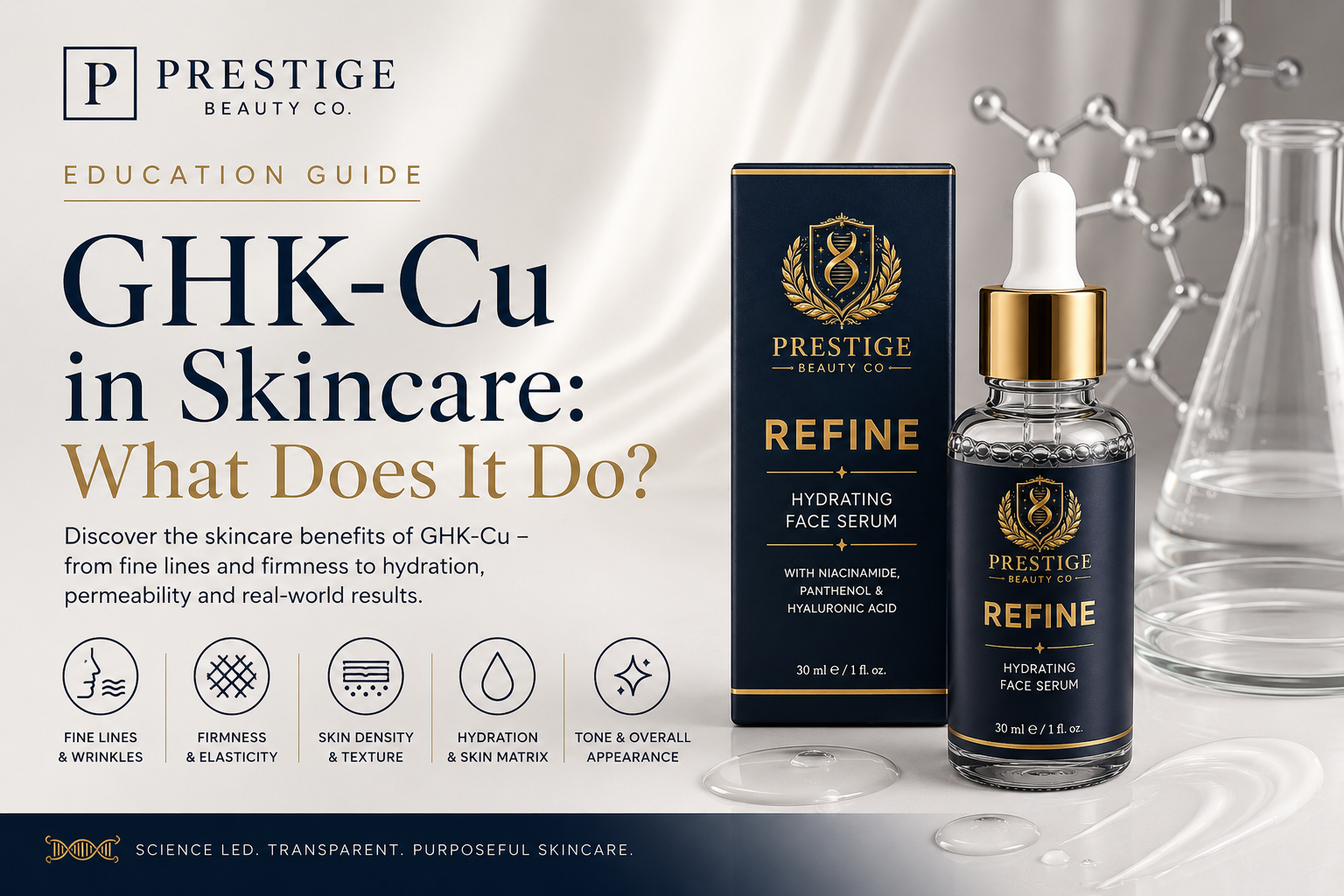
REFINE is Prestige Beauty Co’s hydrating face serum containing GHK-Cu as part of a broader cosmetic formulation.
We don’t think the right way to evaluate REFINE is to isolate one headline ingredient and pretend nothing else in the formula matters.
GHK-Cu is part of the formulation, while the finished serum as a whole determines the experience of applying and using the product.
That philosophy is important to how we approach peptide skincare: understand the ingredient, but evaluate the formulation.
The bottom line
GHK-Cu is used in skincare because laboratory research gives scientists good reasons to be interested in its relationship with processes involving collagen, elastin and other components of the skin’s extracellular matrix.
There are encouraging reports from earlier topical cosmetic research involving characteristics such as fine lines, firmness and skin quality.
But the clinical evidence specifically for topical GHK-Cu remains considerably smaller than its online reputation might suggest, and questions around delivery, permeability and formulation remain important.
The sensible conclusion sits between two extremes.
GHK-Cu isn’t meaningless marketing.
It also isn’t a miracle capable of reversing everything associated with skin ageing.
It is a scientifically interesting cosmetic peptide whose potential makes it worthy of continued research and careful formulation.