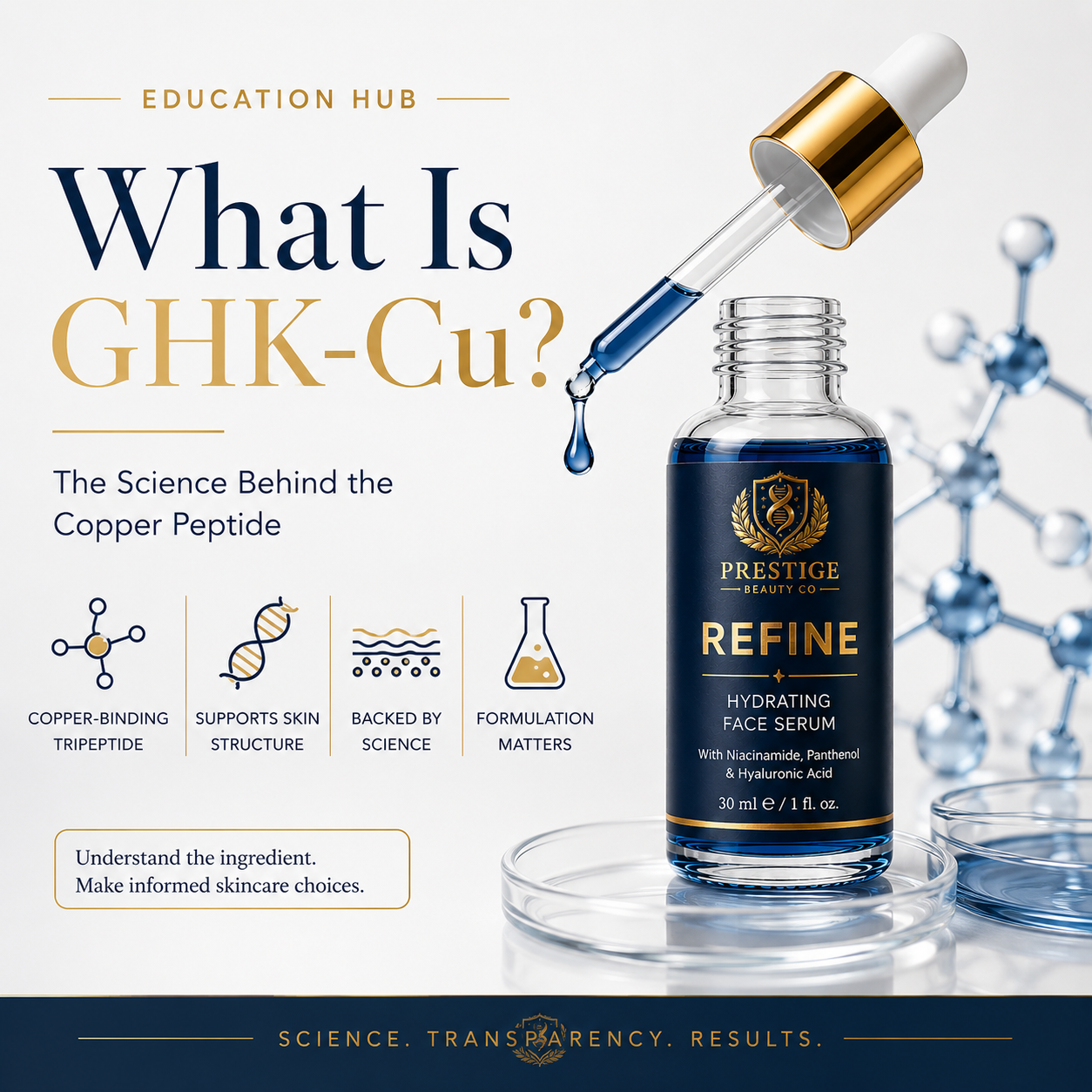
What is GHK-Cu? GHK-Cu is a naturally occurring copper-binding peptide that has attracted increasing attention in skincare. Often described simply as a copper peptide, it combines a short chain of three amino acids with copper.
Its story goes considerably further back than the recent interest in peptide skincare. GHK was first identified in human plasma and has subsequently been investigated for its interactions with processes associated with tissue repair, extracellular matrix activity and skin biology.
Today, GHK-Cu can be found in topical cosmetic formulations including serums and creams, where it is used as part of formulas designed to support the appearance and condition of the skin.
What Is GHK-Cu and What Does It Mean?
The name becomes much easier to understand when broken down.
GHK refers to the three amino acids that form the peptide:
G — Glycine
H — Histidine
K — Lysine
Together they form the tripeptide glycyl-L-histidyl-L-lysine, usually shortened to GHK.
GHK has a strong affinity for copper ions. When it forms a complex with copper, it becomes GHK-Cu.
In cosmetic ingredient lists, you may also encounter the name Copper Tripeptide-1.
Why are peptides used in skincare?
Peptides are short chains of amino acids.
Amino acids are also the building blocks of proteins, including structural proteins found within skin. But describing peptides simply as tiny proteins misses an important part of why cosmetic scientists are interested in them.
Different peptide sequences can interact with biological processes in different ways.
That means “peptides” are not one ingredient. A copper peptide such as GHK-Cu is chemically and functionally different from many of the other peptides found in skincare.
This is why looking at the evidence for the specific peptide matters more than simply seeing the word peptide on a product label.
Why is GHK-Cu interesting for skin?
Much of the scientific interest surrounding GHK-Cu concerns its interaction with processes involved in the skin’s extracellular matrix.
Laboratory research has associated GHK-Cu with fibroblast activity and the production or regulation of components including collagen, elastin and glycosaminoglycans. These structures contribute to properties such as skin firmness, elasticity and hydration.
This provides a plausible scientific basis for investigating GHK-Cu in cosmetic skincare.
We explore the skincare research in more detail in GHK-Cu in Skincare: What Does It Do?
However, there is an important distinction:
Evidence that an ingredient affects cells in a laboratory does not automatically mean a cosmetic applied to the skin will produce the same effect.
The finished formulation, concentration, stability, delivery and ability of an ingredient to reach its intended site within the skin can all influence performance.
That distinction is particularly important with peptides.
What does the research on GHK-Cu show?
There are several layers of evidence.
Laboratory and ex-vivo research provides evidence that GHK-Cu can interact with biological pathways relevant to skin structure and extracellular matrix activity.
Some published reviews also describe small human studies in which topical GHK-Cu formulations were associated with improvements in measures such as the appearance of fine lines, skin firmness, density and thickness.
But the overall clinical evidence base is not as extensive as the popularity of GHK-Cu online might suggest.
A recent scientific review examining topical GHK and its derivatives highlighted the relatively limited amount of published clinical research and identified skin permeability and formulation stability as important areas requiring further investigation.
There are also studies that demonstrate why cautious interpretation matters.
In one randomized study involving 13 people following CO2 laser resurfacing, researchers found no statistically significant objective advantage from GHK-Cu skincare for erythema, wrinkles or overall skin quality compared with the control regimen, although participants using GHK-Cu reported greater satisfaction with overall skin quality.
So the fairest interpretation is not that GHK-Cu is either a miracle ingredient or an ingredient without evidence.
It is a scientifically interesting cosmetic peptide with encouraging research, but one for which the human clinical evidence remains developing.
Is GHK-Cu the same as copper?
No.
Copper is an element and an essential trace mineral.
GHK is a peptide.
GHK-Cu is the complex created when GHK binds a copper ion.
The peptide effectively provides a molecular environment capable of binding copper, which is why the properties of GHK-Cu cannot simply be inferred from copper alone.
This is also why seeing “copper” somewhere in the ingredients of a skincare product does not necessarily mean the product contains GHK-Cu.
Look for Copper Tripeptide-1 in the ingredient list when identifying this particular cosmetic peptide.
Is GHK-Cu the same as every copper peptide?
Not necessarily.
“Copper peptide” is a broad description rather than a guarantee that two ingredients are chemically identical.
GHK-Cu refers specifically to the copper complex of the GHK tripeptide.
This distinction becomes particularly useful when comparing skincare products because the terms GHK-Cu, Copper Tripeptide-1 and copper peptides are frequently used interchangeably in marketing even though the terminology can be broader than the specific molecule being discussed.
We explore this distinction separately in our guide to Copper Peptides vs GHK-Cu: What’s the Difference?
Why is GHK-Cu often blue?
One of the most recognisable characteristics associated with GHK-Cu is its blue colour.
When GHK binds copper, the resulting complex can produce a characteristic blue appearance.
Consequently, formulations containing Copper Tripeptide-1 may have a blue or blue-green tone depending on the concentration and the rest of the formulation.
Colour alone, however, tells you very little about the quality or effectiveness of a finished skincare product.
A darker blue product should not automatically be interpreted as a stronger or better GHK-Cu formulation.
Does more GHK-Cu mean better skincare?
Not automatically.
With cosmetic actives, concentration is only part of formulation.
A finished product also has to consider factors such as:
- ingredient stability
- pH
- interactions with other ingredients
- delivery within the formulation
- skin compatibility
- preservation
- overall formulation design
Peptides can present particular formulation challenges because of their physicochemical characteristics and stability. Research into topical GHK-Cu has also examined the question of skin permeability.
So judging a peptide product solely by the largest percentage printed on the label can be misleading.
A considered formulation matters more than chasing the biggest number.
Where does GHK-Cu fit into a skincare routine?
GHK-Cu is most commonly incorporated into leave-on products such as serums and creams.
A simple routine might look like:
01 — Cleanse
Begin with clean, dry skin.
02 — Serum
Apply your chosen lightweight serum.
03 — Moisturise
Follow with a moisturising cream to complete the routine.
04 — SPF
During the daytime, finish with an appropriate broad-spectrum sunscreen.
There is considerably more nuance when combining peptide products with ingredients such as retinoids, vitamin C and exfoliating acids.
You can explore this further in our guide to How to Use GHK-Cu in Your Skincare Routine.
The bottom line
GHK-Cu is a copper-binding tripeptide composed of glycine, histidine and lysine.
Its relevance to skincare comes from research investigating its interaction with processes involved in skin structure and extracellular matrix biology. Laboratory evidence is substantial enough to make it an interesting cosmetic ingredient, while smaller human studies provide encouraging signals around visible skin characteristics.
At the same time, the clinical evidence for topical GHK-Cu is still more limited than some of the claims made about it online would suggest.
That makes GHK-Cu worth understanding without exaggerating it.
And that is exactly where we think good skincare education should begin.