If you’ve been researching copper peptides vs GHK-Cu, you’ve probably encountered several names that appear to describe the same thing.
Copper peptides. GHK-Cu. Copper Tripeptide-1. GHK. Tripeptide-1.
They’re related, but they don’t all mean exactly the same thing.
The simplest distinction is this:
GHK-Cu is a copper peptide. But the term “copper peptides” is broader than the specific name GHK-Cu.
Understanding the terminology makes ingredient lists much easier to interpret and helps prevent very different peptide ingredients being treated as interchangeable.
What is a copper peptide?
A peptide is a short chain of amino acids.
A copper peptide is, broadly speaking, a peptide associated or complexed with copper.
The phrase therefore describes a type of compound rather than necessarily identifying one unique molecule.
In skincare conversations, however, “copper peptide” is very frequently used as shorthand for GHK-Cu because GHK-Cu is one of the best-known copper-binding peptides used in cosmetics.
That shorthand is convenient, but it can also create confusion.
What exactly is GHK?
GHK is a tripeptide.
Its name comes from the three amino acids that form it:
- G — Glycine
- H — Histidine
- K — Lysine
Together they form glycyl-L-histidyl-L-lysine, usually shortened to GHK.
GHK itself does not mean GHK-Cu.
The distinction is the copper.
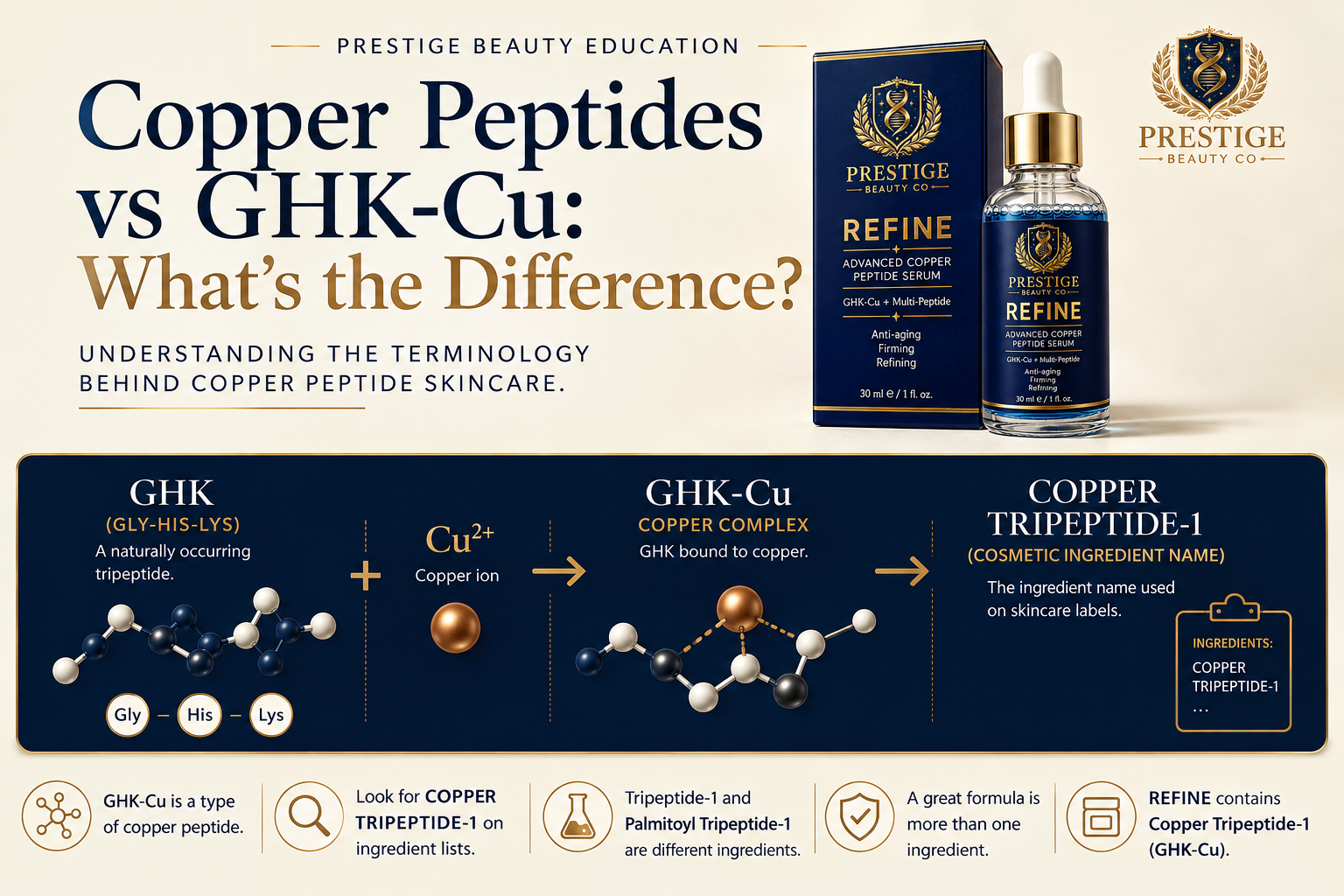
GHK has a strong affinity for copper ions. When GHK forms a complex with copper, the resulting complex is known as GHK-Cu.
If you’d like the deeper background on the molecule itself, read our guide What Is GHK-Cu?
So what is GHK-Cu?
GHK-Cu is the copper complex of the GHK tripeptide.
In simple terms:
GHK + copper = GHK-Cu
The copper ion is coordinated by the peptide, creating a compound with properties that differ from the uncomplexed GHK peptide.
Scientific literature commonly describes GHK-Cu as a copper-binding or copper-carrier peptide and has investigated its interactions with processes involving fibroblasts and components of the extracellular matrix.
This is the form responsible for much of the interest surrounding “copper peptide skincare.”
For a closer look at what that research might mean cosmetically, see GHK-Cu in Skincare: What Does It Do?
Is Copper Tripeptide-1 the same as GHK-Cu?
In cosmetic ingredient terminology, Copper Tripeptide-1 is the name commonly used for GHK-Cu.
This is particularly useful when you’re reading an ingredient list.
The front of a skincare product might advertise:
“GHK-Cu”
or
“Copper Peptides”
while its ingredient list may identify the cosmetic ingredient as:
Copper Tripeptide-1
That does not necessarily mean three different peptide ingredients are present.
They can be different ways of referring to the same underlying copper-GHK complex in different contexts.
PubChem, for example, lists Copper Tripeptide-1 among the names associated with the copper complex of the Gly-His-Lys peptide.
Is Tripeptide-1 the same as Copper Tripeptide-1?
No.
This is where one small word makes an important chemical difference.
Tripeptide-1 refers to GHK.
Copper Tripeptide-1 refers to the copper complex of GHK.
They share the same three-amino-acid peptide sequence, but Copper Tripeptide-1 incorporates copper.
So if you’re specifically looking for GHK-Cu in a cosmetic ingredient list, Copper Tripeptide-1 is the name to look for rather than assuming that any ingredient containing “Tripeptide-1” is GHK-Cu.
Is Palmitoyl Tripeptide-1 a copper peptide?
No.
Palmitoyl Tripeptide-1 is another ingredient that can easily cause confusion because it is derived from the GHK sequence.
Instead of complexing GHK with copper, Palmitoyl Tripeptide-1 attaches a fatty acid called palmitic acid to the peptide.
This creates Pal-GHK.
The modification is used in part to change characteristics such as lipophilicity and skin delivery.
So:
GHK = the Gly-His-Lys tripeptide
GHK-Cu = GHK complexed with copper
Pal-GHK = GHK modified with palmitic acid
These compounds are related, but they are not interchangeable names for the same ingredient.
Are all peptides in skincare copper peptides?
Definitely not.
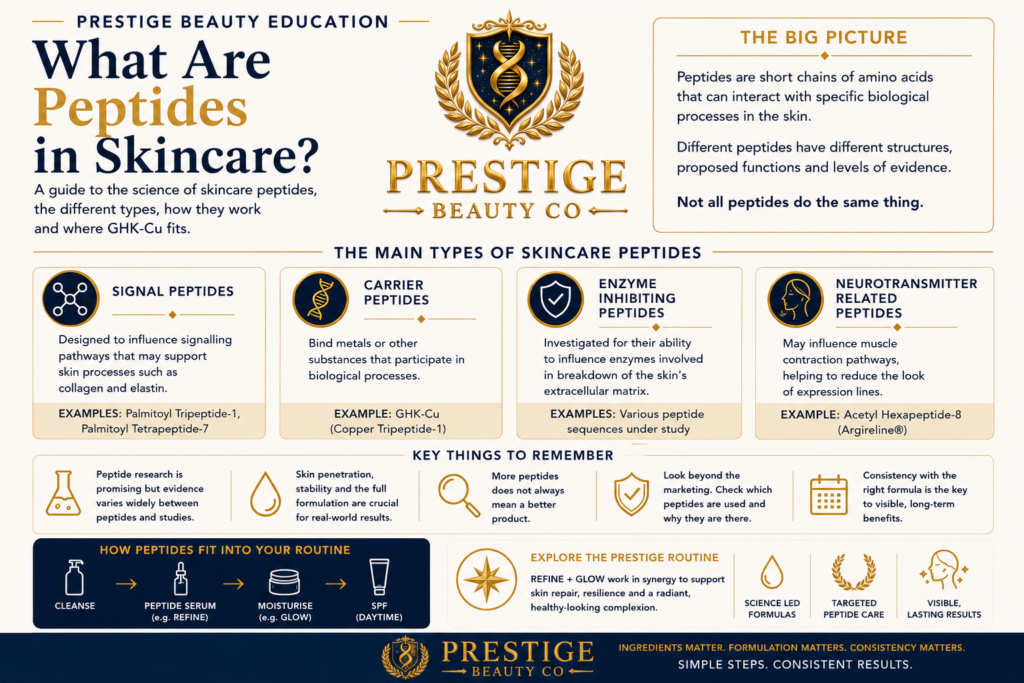
There are many cosmetic peptides with different amino-acid sequences, structures and proposed functions.
Examples include signal peptides, carrier peptides and neurotransmitter-inhibiting peptides.
Copper Tripeptide-1 is generally discussed as a carrier peptide because of GHK’s ability to bind copper.
Other well-known cosmetic peptides include ingredients such as Palmitoyl Pentapeptide-4, Palmitoyl Tripeptide-1 and Acetyl Hexapeptide-8.
They shouldn’t be assumed to work identically simply because the word “peptide” appears in each name.
“Peptide” describes an enormous family of molecules.
The specific peptide matters.
For a broader introduction to how these ingredients are used in cosmetics, read What Are Peptides in Skincare?
Does “copper” on an ingredient list mean GHK-Cu?
Not necessarily.
Copper is an element, and it can appear in different compounds and complexes.
Seeing a copper-containing ingredient therefore does not automatically tell you that a product contains GHK-Cu.
Likewise, a product being blue is not proof that it contains Copper Tripeptide-1.
GHK-Cu is characteristically blue, but colour alone is not a reliable way to identify a cosmetic ingredient.
If you specifically want to determine whether a skincare formulation contains GHK-Cu, examine the ingredient declaration rather than relying on colour, marketing terminology or packaging.
What should I look for on a skincare ingredient list?
For a cosmetic formulated with GHK-Cu, the important name to recognise is:
Copper Tripeptide-1
That is considerably more useful than trying to judge a product from phrases such as:
“copper complex”
“copper technology”
“peptide complex”
or simply:
“peptides”
Marketing language can describe a product in many ways.
The ingredient list tells you what cosmetic ingredients have actually been declared in the formulation.
It is also worth remembering that identifying Copper Tripeptide-1 tells you that the ingredient is present.
It does not, by itself, tell you everything about the finished product.
Does Copper Tripeptide-1 on the label tell me how good the product is?
No.
An ingredient list is extremely useful, but it cannot tell you everything about formulation quality or performance.
A finished peptide product also depends on factors including:
- concentration
- stability
- pH
- compatibility with other ingredients
- formulation vehicle
- preservation
- packaging
- how the product is stored
Peptides can present formulation challenges, particularly around stability and skin delivery.
This is why comparing skincare solely by looking for the longest peptide list or the biggest advertised percentage can be misleading.
A finished cosmetic formulation matters more than its headline ingredient alone.
Copper peptides vs GHK-Cu: which is better?
This question is based on a slightly misleading comparison.
GHK-Cu isn’t really an alternative to copper peptides.
GHK-Cu is itself a copper peptide.
It is similar to asking whether a particular type of something is better than the category it belongs to.
The more useful question is:
Which copper peptide does this product actually contain?
If the answer is Copper Tripeptide-1, then you’re looking at the cosmetic ingredient commonly associated with GHK-Cu.
From there, the quality and suitability of the overall formulation become more important than the terminology used on the front of the packaging.
Why does the terminology matter?
Because skincare marketing often compresses complicated chemistry into simple phrases.
That’s understandable.
Nobody wants an ingredient list printed across the front of every bottle.
But simplification becomes a problem when different ingredients start being treated as though they’re identical.
Understanding the terminology helps you distinguish between:
- a general product claim about copper peptides
- GHK itself
- the GHK-Cu complex
- Copper Tripeptide-1
- Palmitoyl Tripeptide-1
- other unrelated cosmetic peptides
That makes it much easier to compare products intelligently.
Where does REFINE fit?
REFINE contains Copper Tripeptide-1, the cosmetic ingredient associated with GHK-Cu.
We describe it as part of the complete REFINE formulation rather than suggesting that the presence of one fashionable peptide determines everything about the serum.
That distinction reflects the same principle discussed throughout this Education Hub:
Understand individual ingredients, but judge skincare as a finished formulation.
The bottom line
“Copper peptides” and “GHK-Cu” are often used interchangeably in everyday skincare discussions, but technically they are not identical terms.
Copper peptide is the broader description.
GHK is the three-amino-acid peptide Gly-His-Lys.
GHK-Cu is GHK complexed with copper.
In cosmetic ingredient terminology, Copper Tripeptide-1 is the important name to recognise when looking for GHK-Cu in a skincare formula.
And ingredients such as Tripeptide-1 and Palmitoyl Tripeptide-1, although related to GHK, should not simply be treated as alternative names for GHK-Cu.
Once those distinctions are understood, copper peptide skincare becomes considerably easier to navigate.
The underlying terminology here is supported by chemical databases and recent reviews: PubChem identifies GHK-Cu/copper tripeptide as the copper complex whose parent peptide is Gly-His-Lys, while dermatology literature distinguishes Copper Tripeptide-1 (Cu-GHK) from Palmitoyl Tripeptide-1 (Pal-GHK).