How to use GHK-Cu is one of the most common questions surrounding copper peptide skincare, because knowing what an ingredient is and knowing how to use it are two different things.
Should it go before moisturiser?
Can you use it morning and evening?
Where do serums and creams fit?
And do you really need to avoid vitamin C, retinoids and exfoliating acids?
The good news is that a GHK-Cu skincare routine does not need to be complicated.
If you’re new to the ingredient itself, start with What Is GHK-Cu? or explore the research in GHK-Cu in Skincare: What Does It Do?
For most people, the same principle that works for good skincare generally applies here:
Cleanse, apply lighter treatment products, moisturise, and protect your skin from the sun during the day.
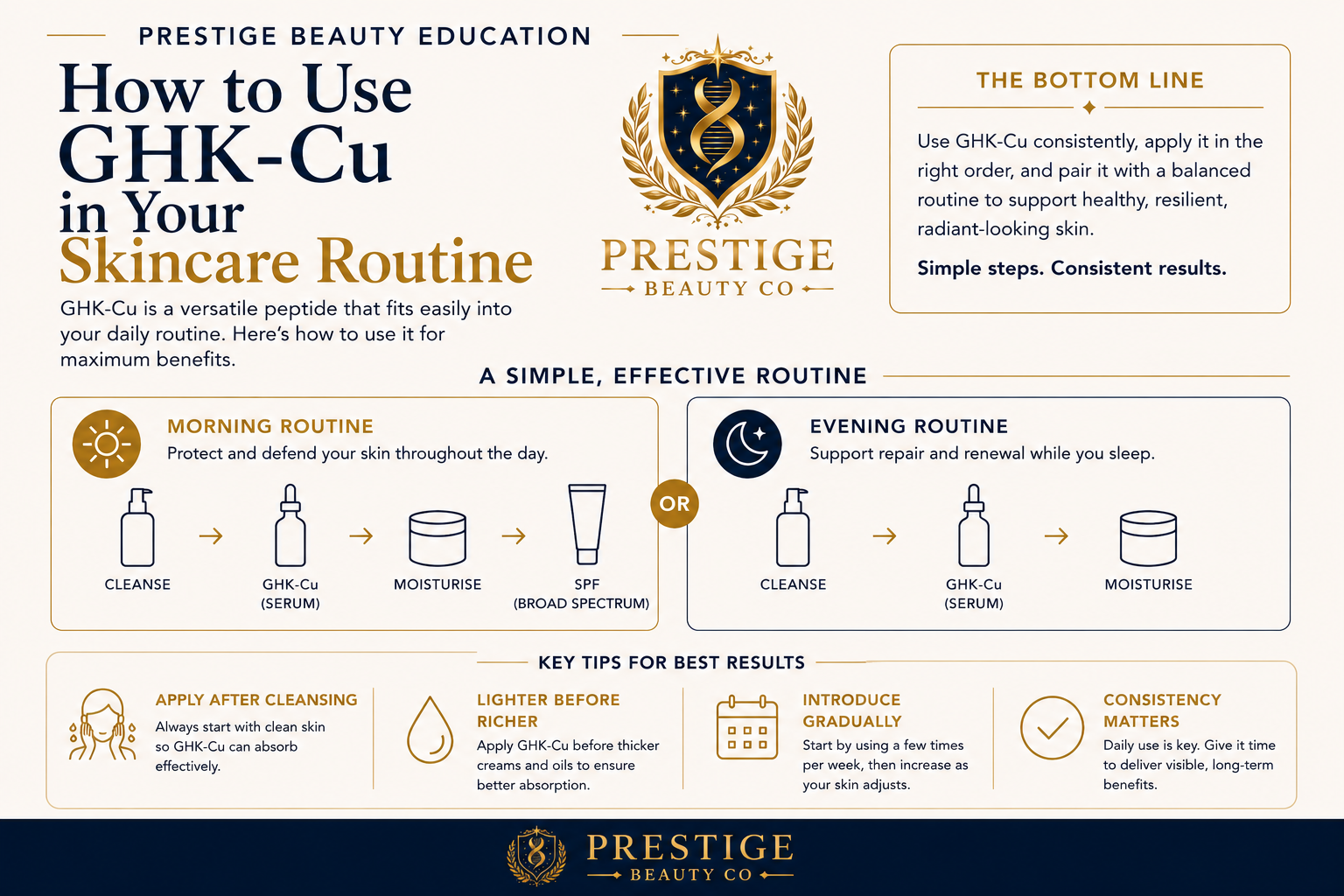
How to use GHK-Cu in a skincare routine
GHK-Cu is commonly incorporated into leave-on skincare products such as serums and creams.
Where the product belongs in your routine therefore depends partly on the formulation rather than simply on the presence of GHK-Cu.
A lightweight serum will generally be applied before a richer moisturising cream.
A simple routine might look like:
01 — Cleanse
Begin with clean, dry skin.
02 — Serum
Apply your lightweight leave-on serum.
03 — Moisturise
Follow with a moisturising cream where needed.
04 — SPF
During the daytime, finish with broad-spectrum sunscreen.
There is usually no reason to build an elaborate routine simply because one of your products contains a copper peptide.
Should GHK-Cu serum go before or after moisturiser?
Usually before.
Serums tend to have lighter textures than moisturising creams, so applying the serum first allows it to sit directly within the earlier treatment stage of your routine.
Once it has been applied, follow with your moisturiser.
This gives us the straightforward sequence:
Cleanser → GHK-Cu serum → moisturiser → SPF during the day
However, texture matters more than blindly following a rule.
If you’re using an unusual formulation, follow the manufacturer’s directions for that particular product.
Can you use a GHK-Cu cream instead?
Yes.
GHK-Cu does not have to appear in a serum.
It can be incorporated into different topical cosmetic formats, including creams.
If your copper peptide is already contained in your moisturising cream, you do not need to add a separate GHK-Cu serum simply to create a complete routine.
Your routine could instead be:
Cleanser → optional lightweight serum → GHK-Cu cream → SPF
This is particularly relevant when comparing products because two formulations can contain the same headline peptide while serving quite different roles within a routine.
What if I use both a serum and a cream?
This is where layering becomes useful.
If you use a lightweight serum and a moisturising cream, the serum would normally come first.
For example:
Cleanse → REFINE serum → GLOW cream → SPF
REFINE and GLOW have different formulation roles.
REFINE is the lighter serum stage.
GLOW is the moisturising cream stage.
Using both therefore isn’t about applying the same product twice. It is about layering two different finished formulations according to their texture and purpose.
You also don’t have to use both.
A good routine should suit your skin rather than contain the maximum possible number of products.
Can I use GHK-Cu in the morning?
Yes, a cosmetic product containing GHK-Cu can form part of a morning skincare routine unless its own directions state otherwise.
A straightforward morning routine could be:
Cleanse
GHK-Cu serum
Moisturiser
Broad-spectrum SPF
Sunscreen remains the most important final daytime step.
GHK-Cu should not be viewed as a substitute for sun protection.
Can I use GHK-Cu at night?
Yes.
An evening routine can be even simpler:
Cleanse
GHK-Cu serum
Moisturiser
There is no requirement to use a long sequence of products simply because you are using peptide skincare.
Consistency with a sensible routine is generally more useful than constantly adding additional active ingredients.
How often should you use GHK-Cu?
This depends on the finished cosmetic product.
If a GHK-Cu serum or cream has been formulated and directed for daily use, follow those product directions.
Some people prefer introducing any new leave-on skincare product gradually, particularly if they already use several active products.
That also makes it easier to identify which product is responsible if irritation occurs.
More applications do not automatically mean better results.
Can GHK-Cu be used with hyaluronic acid?
There is no general reason that GHK-Cu and hyaluronic acid cannot appear within the same skincare routine.
Hyaluronic acid is widely used as a humectant in moisturising formulations.
In fact, finished cosmetics can contain both peptide ingredients and hyaluronic acid within the same formula.
Rather than worrying about whether two fashionable ingredient names can theoretically coexist, it is usually more useful to consider how the complete formulations fit together.
Can GHK-Cu be used with niacinamide?
Again, there is no universal rule requiring niacinamide and GHK-Cu to be separated into different routines.
Niacinamide is widely used in cosmetic formulations and can form part of the same broader skincare routine as peptide products.
REFINE itself demonstrates an important point here: a modern skincare product is a complete formulation, not a single ingredient floating in isolation.
This is why ingredient compatibility questions should not automatically be reduced to simple internet lists of “safe” and “unsafe” combinations.
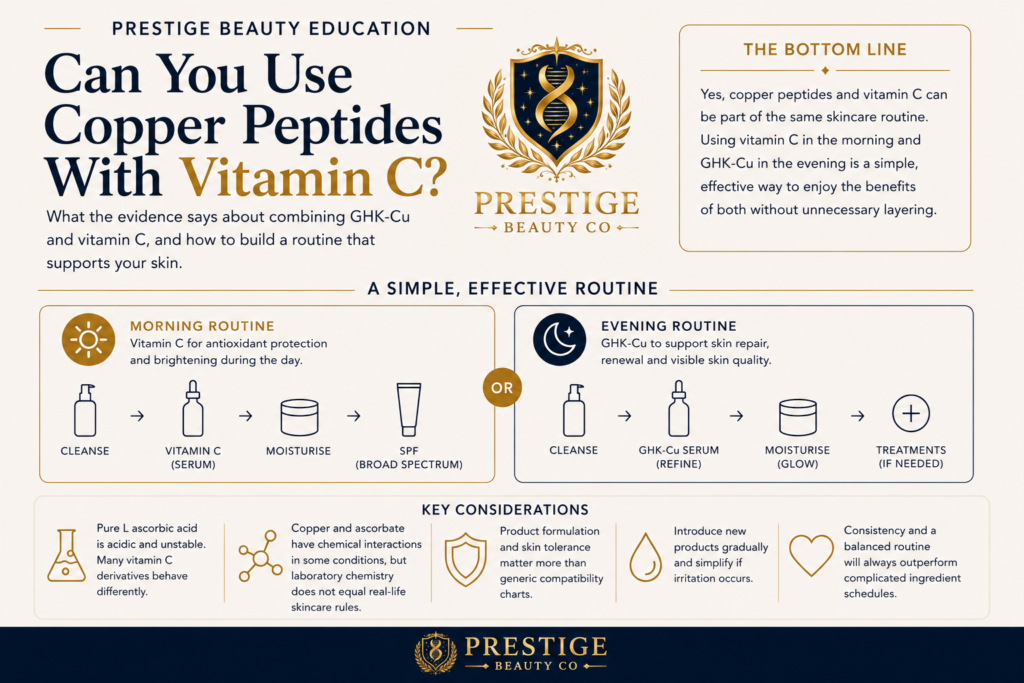
What about vitamin C?
This requires a little more nuance.
You may encounter advice online saying that copper peptides must never be used alongside vitamin C.
That is too absolute.
“Vitamin C” can refer to different cosmetic ingredients and formulations, and the behaviour of a finished product depends on factors including concentration, pH, stability and the complete formulation.
GHK-Cu itself can also present formulation challenges because peptides and metal complexes can be sensitive to their chemical environment. Research into topical GHK and GHK-Cu specifically identifies physicochemical stability and formulation as important considerations.
That does not establish a universal rule that every vitamin C product and every GHK-Cu cosmetic must never be used within the same skincare routine.
If you prefer a simple approach when using multiple active products, you can separate them:
Vitamin C in the morning
GHK-Cu in the evening
But that is a practical routine choice, not evidence of a universal incompatibility.
We examine this question in more detail in Can You Use Copper Peptides With Vitamin C?
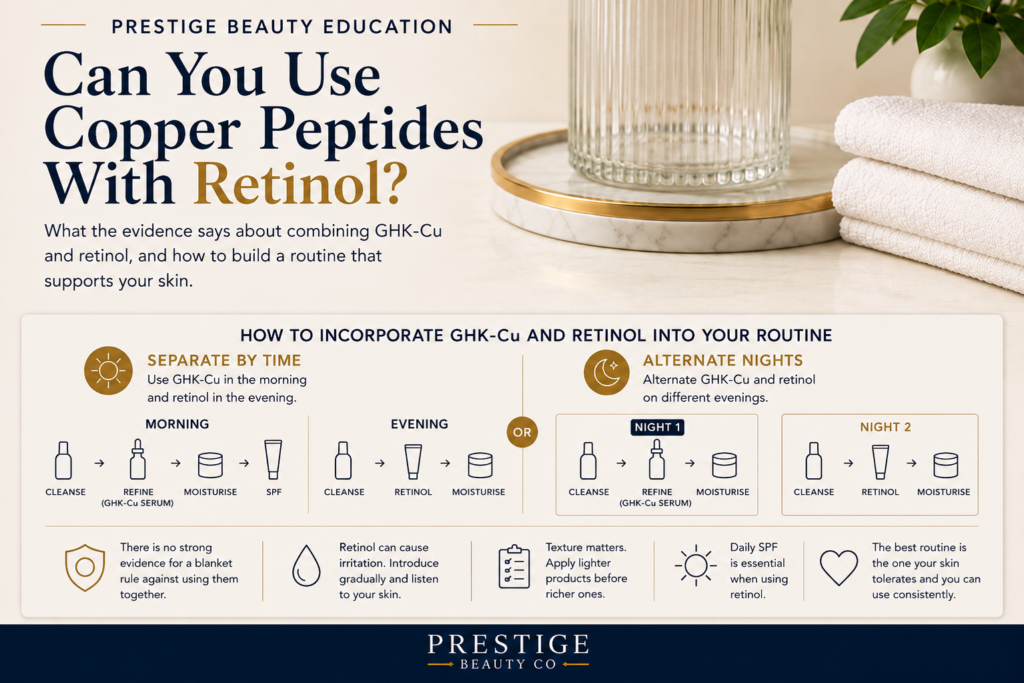
Can you use GHK-Cu with retinoids?
This is another area where online skincare advice often becomes unnecessarily absolute.
There is not good evidence for a blanket rule stating that topical GHK-Cu and every cosmetic retinoid can never appear within the same skincare routine.
However, retinoids can themselves be irritating for some users.
If your routine already contains a retinoid, introducing another product gradually is sensible.
People who prefer to keep active stages separate could alternate routines or use the products at different times.
For example:
Morning — GHK-Cu
Evening — retinoid
or alternate them on different evenings.
Again, this is primarily about creating a manageable routine and monitoring skin tolerance rather than assuming the two ingredients chemically “cancel each other out.”
For a closer look at the evidence and practical options, read Can You Use Copper Peptides With Retinol?
What about AHAs and BHAs?
Exfoliating acids can also cause irritation when overused.
The practical issue is therefore often total routine intensity rather than GHK-Cu alone.
If you already use glycolic acid, lactic acid, salicylic acid or another exfoliating treatment, you do not need to pile every active product into the same application.
Alternating products can make a routine easier to tolerate and easier to understand.
For example:
Night 1 — GHK-Cu routine
Night 2 — exfoliating treatment
The appropriate frequency depends on the individual products and your skin.
Do I need to wait between skincare layers?
Usually, you do not need to stand in front of the mirror timing long intervals between ordinary cosmetic layers.
Apply the serum evenly and allow it enough time to settle comfortably before applying the next product.
You do not generally need a rigid ten, twenty or thirty-minute countdown.
If a particular product gives specific instructions about application or waiting time, follow those directions.
Should GHK-Cu be applied to wet or dry skin?
Follow the instructions for the finished product.
For a conventional leave-on serum, applying it to clean skin and allowing it to absorb before the next step keeps the routine simple.
The important point is that the behaviour of a formulated cosmetic cannot be determined solely from the name of one ingredient.
Can you use too many peptide products?
You can certainly make a routine more complicated than it needs to be.
Using multiple peptide products does not automatically produce proportionally greater cosmetic results.
Products may contain overlapping ingredients, and every additional layer adds another formulation your skin has to tolerate.
A considered routine asks:
What role does this product actually perform?
If a serum provides the treatment stage and a cream provides moisturisation, that is a logical combination.
Adding several additional products purely because they also contain peptides may offer little practical benefit.
A simple GHK-Cu morning routine
For someone who wants to keep things straightforward:
01 — Cleanse
Use your normal cleanser.
02 — REFINE
Apply your lightweight serum.
03 — GLOW
Apply moisturising cream if required.
04 — SPF
Finish with broad-spectrum sunscreen.
That’s it.
You do not need ten steps to create a considered skincare routine.
A simple GHK-Cu evening routine
The evening version is even shorter:
01 — Cleanse
Remove sunscreen, makeup and the day’s surface build-up.
02 — REFINE
Apply your serum.
03 — GLOW
Finish with moisturising cream where required.
If you use other active products such as retinoids or exfoliating acids, you can build those around this basic framework according to their directions and your skin’s tolerance.
What if my skin becomes irritated?
Stop adding more products.
Redness, persistent stinging, burning, itching or worsening irritation is not something you need to “push through” simply because an ingredient is popular.
Reduce the complexity of the routine and identify which product may be causing the problem.
People with persistent skin problems or diagnosed skin conditions should seek appropriate professional advice rather than relying on increasingly complicated cosmetic routines.
The bottom line
Using GHK-Cu in skincare does not need to be complicated.
The basic principle is:
Cleanse → serum → moisturise → SPF during the day
A GHK-Cu serum normally fits before moisturiser, while a GHK-Cu cream can occupy the moisturising stage itself.
REFINE followed by GLOW therefore creates a logical serum-and-cream sequence within the Prestige routine.
And despite the long lists of forbidden ingredient combinations found online, skincare compatibility is more nuanced than declaring entire ingredient categories universally incompatible.
Pay attention to the finished formulation, follow its directions, introduce new products sensibly and build a routine your skin actually tolerates.
Good skincare does not need to be complicated to be considered.