Yes, copper peptides and retinol can form part of the same skincare routine.
There is not strong evidence supporting a blanket rule that GHK-Cu and retinol must never be used together.
The more useful question is whether you need to apply them at the same time.
For many people, separating the two can create a simpler routine, particularly when retinol is new to the skin or already causes dryness or irritation.
Why are people told not to use copper peptides with retinol?
Skincare compatibility advice often turns complicated formulation questions into simple rules.
One of those rules is:
Never use copper peptides with retinol.
The scientific evidence does not justify such an absolute statement.
GHK-Cu and retinol are very different ingredients with different chemical properties and different bodies of research behind them.
There are genuine formulation considerations when working with peptides, including stability, pH, delivery and interactions within a finished formula.
That is different from demonstrating that applying a GHK-Cu cosmetic and a retinol cosmetic within the same skincare routine is inherently incompatible.
What does retinol do?
Retinol is a vitamin A derivative and belongs to the wider retinoid family.
Topical retinoids have been extensively investigated for their effects on ageing and photodamaged skin.
Research has associated retinoid use with changes involving epidermal turnover, collagen production and other processes relevant to visible skin ageing.
This gives retinoids a substantial evidence base in skincare.
But there is a trade off.
Retinoids can also cause irritation.
Redness, dryness, peeling, burning and stinging are well recognised, particularly during the early stages of use.
What does GHK-Cu do?
GHK-Cu is a copper binding tripeptide.
Research has investigated its relationship with fibroblast activity and components of the extracellular matrix, including collagen.
There are encouraging findings surrounding its potential relevance to visible characteristics of ageing skin.
However, the human clinical evidence for topical GHK-Cu is considerably smaller than the evidence base surrounding retinoids.
That distinction is worth understanding when comparing the two.
For a deeper look at GHK-Cu itself, see What Is GHK-Cu? and GHK-Cu in Skincare: What Does It Do?
Do GHK-Cu and retinol cancel each other out?
There is not good clinical evidence demonstrating that applying GHK-Cu and retinol within the same skincare routine causes them to simply cancel each other out.
That phrase makes skincare chemistry sound much simpler than it really is.
The behaviour of an ingredient depends on the finished formulation, including factors such as:
- concentration
- pH
- stability
- formulation vehicle
- packaging
- other ingredients
- application conditions
Research into topical GHK-Cu specifically identifies stability and delivery as important formulation considerations.
That does not establish a universal consumer rule that retinol destroys GHK-Cu or that GHK-Cu makes retinol ineffective.
Can you use GHK-Cu and retinol on the same night?
Potentially, yes.
But being able to use two products together does not mean you need to.
If your skin already tolerates both products individually, using them within the same evening routine may be reasonable when their individual product directions allow it.
A simple sequence would normally follow product texture:
Cleanse → lighter serum → treatment or moisturising products
However, if retinol causes dryness, peeling or irritation, adding more active products to the same application may make the routine unnecessarily complicated.
In that situation, separating them is often the simpler approach.
Which should you apply first?
There is no universal rule based purely on the names GHK-Cu and retinol.
The finished products matter.
If your GHK-Cu product is a lightweight serum and your retinol product is a richer cream, the serum would normally come first based on texture.
If the formulations are different, the sequence may also differ.
Follow the directions supplied with each product rather than assuming every copper peptide serum and every retinol product behaves identically.
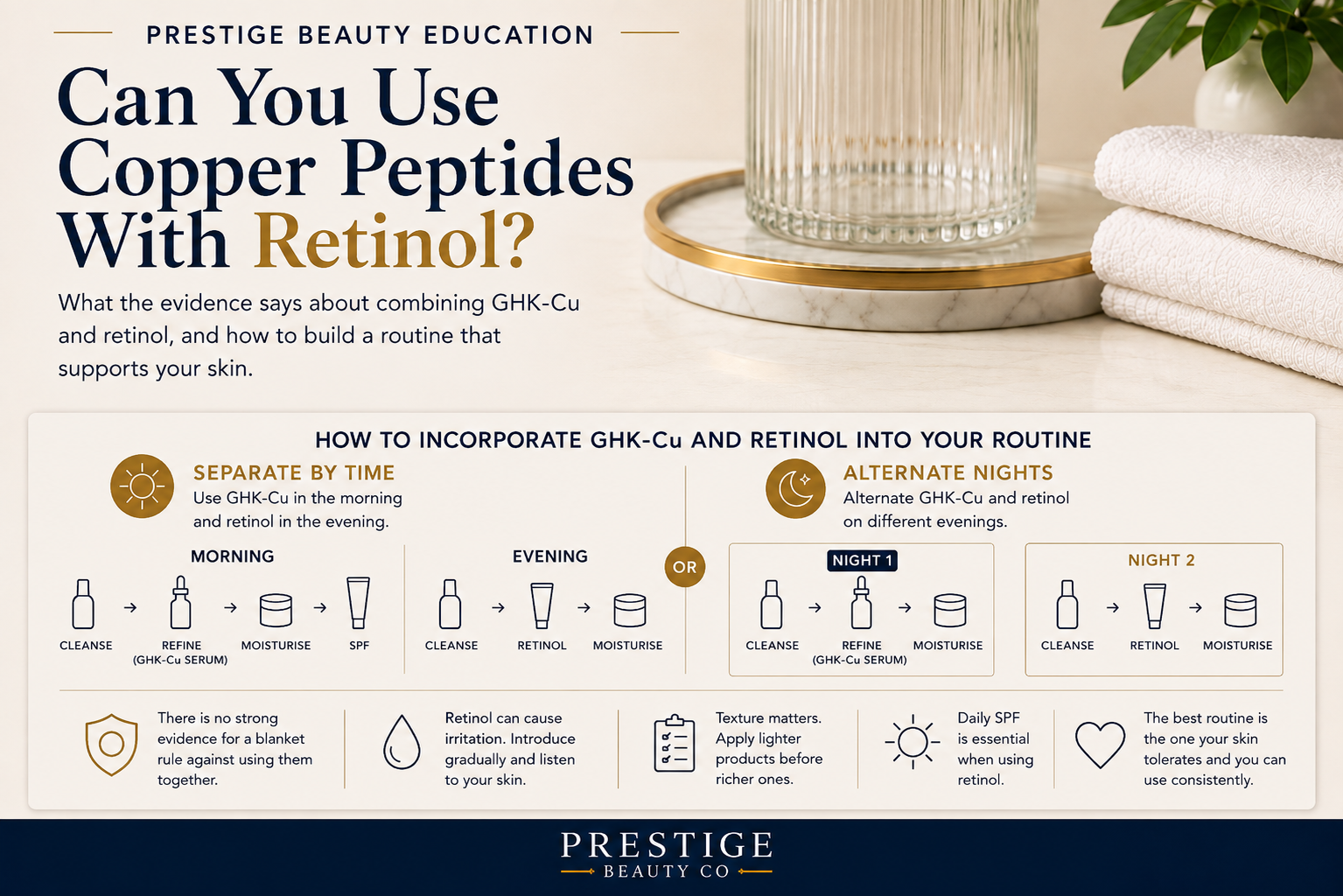
Is it better to use GHK-Cu in the morning and retinol at night?
For many people, this is an extremely straightforward option.
For example:
Morning
Cleanse
GHK-Cu serum
Moisturiser
Broad spectrum SPF
Evening
Cleanse
Retinol
Moisturiser
This approach separates the products without requiring a complicated schedule.
It also places retinol within the evening routine, which is common practice for retinoid skincare.
Daily sun protection remains particularly important when using a retinoid routine.
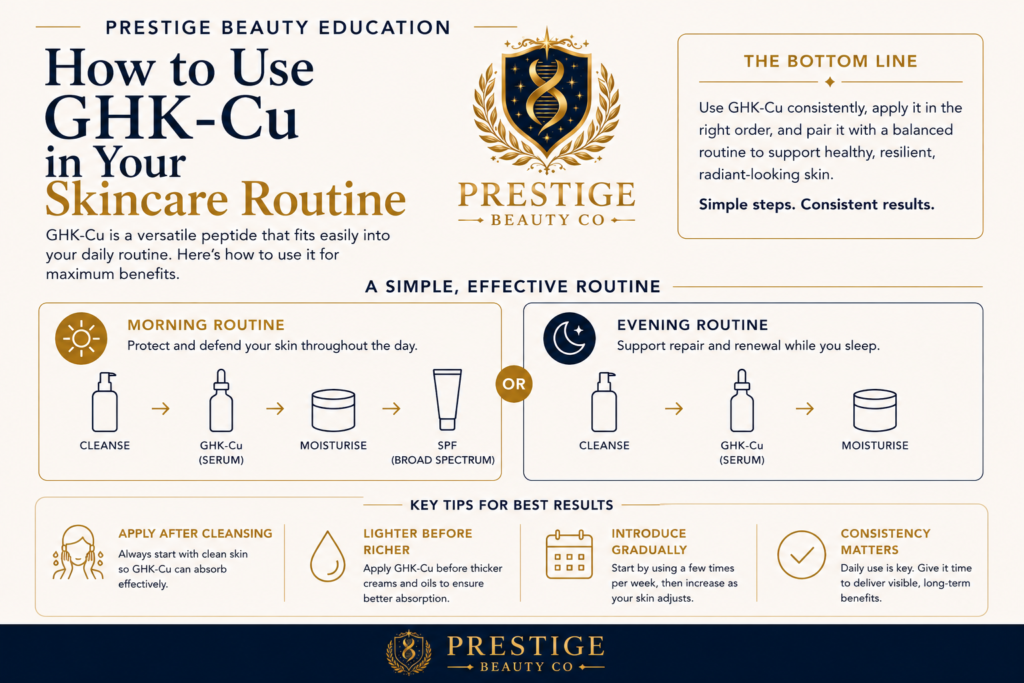
For more practical guidance on product order and timing, see How to Use GHK-Cu in Your Skincare Routine.
Can you alternate GHK-Cu and retinol on different nights?
Yes.
Alternating nights is another simple approach, particularly when introducing retinol.
For example:
Night 1
Cleanse
GHK-Cu serum
Moisturiser
Night 2
Cleanse
Retinol
Moisturiser
Then repeat according to your skin’s tolerance and the directions of the products being used.
Alternating does not mean the ingredients have been proven incompatible.
It is simply a practical way to reduce the number of active products being applied at once.
What if you are new to retinol?
This is where restraint becomes particularly useful.
Retinoid irritation is well documented and can include dryness, redness, scaling, burning and stinging. Research also shows that irritation frequently occurs during the early stages of topical retinoid use.
If you’re introducing retinol for the first time, adding several other new active products simultaneously makes it much harder to understand how your skin is responding.
A simpler approach is to introduce one product first.
Once your skin is comfortable with that routine, you can decide whether another product actually needs to be added.
What if you have sensitive skin?
The same principle becomes even more important.
Sensitive or reactive skin does not benefit from collecting the largest possible number of active ingredients.
If retinol already causes irritation, there is little reason to force GHK-Cu into the same application simply because both ingredients are popular.
Using GHK-Cu at a different time or on different evenings can keep the routine easier to tolerate and easier to troubleshoot.
Your skin does not know how impressive your ingredient list looks.
Is GHK-Cu an alternative to retinol?
Not really.
They are different ingredients with different research histories.
Retinoids have a substantial body of clinical evidence behind their use for visible signs of photoageing.
GHK-Cu has interesting laboratory evidence and encouraging smaller human studies, but the clinical evidence is less extensive.
That means GHK-Cu should not simply be presented as “natural retinol” or as a scientifically equivalent replacement.
Someone may prefer a peptide focused routine for many reasons, but that is different from claiming that the two ingredients are interchangeable.
Can you use REFINE with retinol?
REFINE can form part of a skincare routine that also contains a retinol product.
How you organise that routine depends on the retinol formulation you use and how your skin tolerates it.
One straightforward option is:
Morning
REFINE
Moisturiser
SPF
Evening
Retinol
Moisturiser
Another is to use REFINE and retinol on alternating evenings.
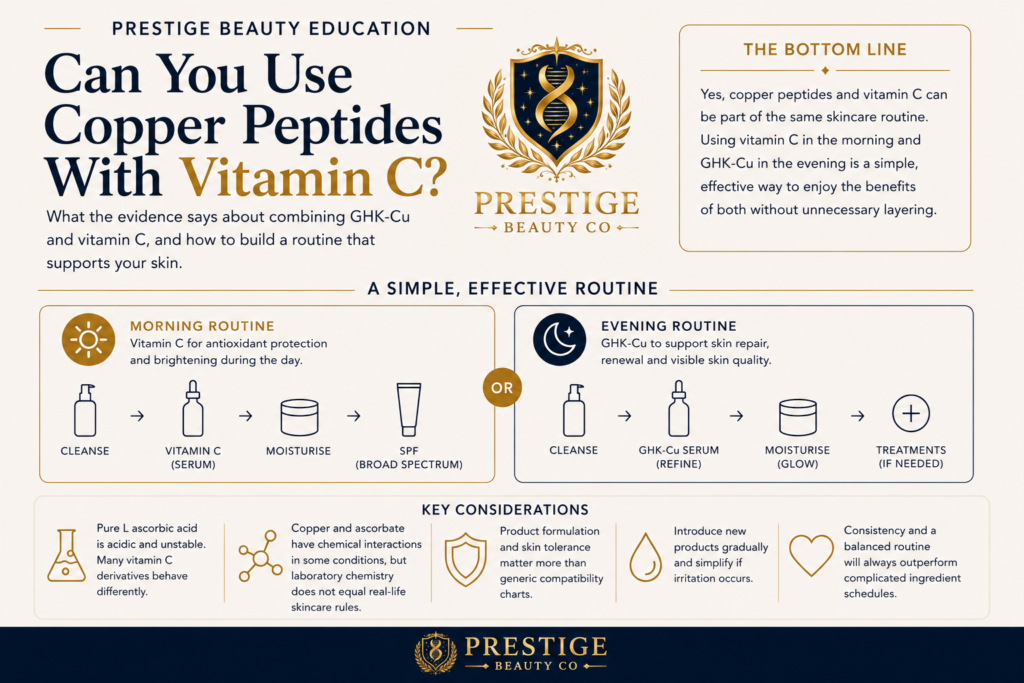
You can also read Can You Use Copper Peptides With Vitamin C? if vitamin C forms part of your wider skincare routine.
There is no prize for putting every active product onto your face at exactly the same time.
What about GLOW?
If you use REFINE and GLOW together, REFINE occupies the lighter serum stage and GLOW the cream stage.
On a non retinol evening, that creates a simple sequence:
Cleanse → REFINE → GLOW
If your retinol product already contains a moisturising base, you may not need another cream over it.
Again, the finished products and your skin should determine the routine rather than a rigid internet formula.
When should you simplify the routine?
If you experience persistent:
- redness
- burning
- stinging
- peeling
- itching
- uncomfortable dryness
reduce the complexity of the routine.
Do not keep adding products in an attempt to correct irritation caused by another product.
Persistent or significant skin problems deserve appropriate professional advice.
The bottom line
Yes, copper peptides and retinol can exist within the same skincare routine.
There is not strong evidence supporting the blanket claim that GHK-Cu and retinol must never be used together.
But there is also no compelling reason to apply every active ingredient simultaneously.
Retinol has a substantial evidence base but can cause irritation, particularly during introduction. GHK-Cu has promising research but a smaller human clinical evidence base.
Using GHK-Cu in the morning and retinol at night, or alternating them on different evenings, are both simple ways to incorporate the ingredients without unnecessarily complicating your routine.
The best routine is not the one containing the most actives.
It is the one your skin tolerates and you can use consistently.