Yes, copper peptides and vitamin C can form part of the same skincare routine.
There is not strong clinical evidence supporting a blanket rule that every GHK-Cu product and every vitamin C product must always be kept apart.
However, vitamin C is not one single cosmetic ingredient.
Pure L ascorbic acid behaves differently from many vitamin C derivatives, and the formulation of both products matters.
For someone who wants the simplest approach, using vitamin C and GHK-Cu at different times of day is perfectly reasonable.
Why are people told not to use copper peptides with vitamin C?
This advice appears frequently in skincare routines:
Never use copper peptides with vitamin C.
The reality is more complicated.
GHK-Cu is a copper binding peptide.
If you’re new to the ingredient, our guide What Is GHK-Cu? explains the peptide and its relationship with copper in more detail.
Vitamin C products can contain L ascorbic acid or one of several vitamin C derivatives.
Those different ingredients can have different pH requirements, stability characteristics and formulation behaviour.
There are legitimate chemical considerations involving ascorbic acid, copper and peptide stability.
But formulation chemistry should not automatically be converted into a universal rule that two finished cosmetic products can never exist within the same skincare routine.
What is vitamin C in skincare?
Vitamin C is widely used in skincare for its antioxidant properties.
Research has investigated topical vitamin C for photodamage, pigmentation and visible characteristics associated with skin ageing.
The form with the strongest established research history is L ascorbic acid.
But L ascorbic acid presents a formulation challenge.
It is water soluble, unstable and susceptible to oxidation.
For effective skin penetration, topical L ascorbic acid is commonly formulated at an acidic pH below approximately 3.5.
This is important because not every ingredient or finished skincare product is designed to operate under the same conditions.
Are all vitamin C products the same?
No.
This is one of the biggest problems with simple skincare compatibility charts.
A product labelled “vitamin C” might contain:
• L ascorbic acid
• magnesium ascorbyl phosphate
• ascorbyl palmitate
• tetrahexyldecyl ascorbate
• 3 O ethyl ascorbic acid
• another vitamin C derivative
These ingredients do not all behave identically.
Some derivatives were developed partly to address the stability and formulation challenges associated with pure L ascorbic acid.
So asking whether GHK-Cu can be used with “vitamin C” does not have one perfect answer unless you know which vitamin C ingredient and which finished formulations are involved.
What is different about L ascorbic acid?
L ascorbic acid deserves particular attention because it is both well studied and chemically challenging.
It oxidises relatively easily and its stability can be influenced by factors including:
• light
• oxygen
• temperature
• pH
• formulation environment
• metal ions
Research also shows that low pH plays an important role in topical delivery.
That is why many L ascorbic acid serums are deliberately acidic.
This is a formulation characteristic, not evidence that vitamin C is somehow a bad skincare ingredient.
It simply means the finished formulation matters.
What about copper and vitamin C chemistry?
This is where the compatibility question becomes scientifically interesting.
Ascorbic acid is a reducing agent, while copper is a redox active metal.
Under certain experimental conditions, copper ions and ascorbate can participate in oxidation reactions.
Laboratory research has also demonstrated that metal catalysed oxidation can affect peptides under particular chemical conditions.
That gives formulators genuine reasons to think carefully about stability when combining certain ingredients within a single formulation.
But there is an important distinction.
A controlled chemical system in a laboratory is not automatically equivalent to applying two separately formulated cosmetic products to human skin.
This is why we should be cautious about making absolute claims in either direction.
Does vitamin C destroy GHK-Cu?
We have not found convincing human clinical evidence demonstrating that applying a vitamin C cosmetic and a GHK-Cu cosmetic within the same skincare routine simply destroys the GHK-Cu.
That claim is stronger than the available evidence supports.
There are plausible formulation concerns involving pH, oxidation and metal chemistry.
Those concerns matter greatly when a cosmetic chemist is developing and stability testing a finished product.
They do not automatically prove that consumers must never use the ingredients within the same overall routine.
Can you use GHK-Cu and vitamin C at the same time?
Potentially.
But there is also no requirement to layer them together.
If you already have a vitamin C product that you enjoy using and a GHK-Cu product you want to introduce, separating them is an extremely simple solution.
For example:
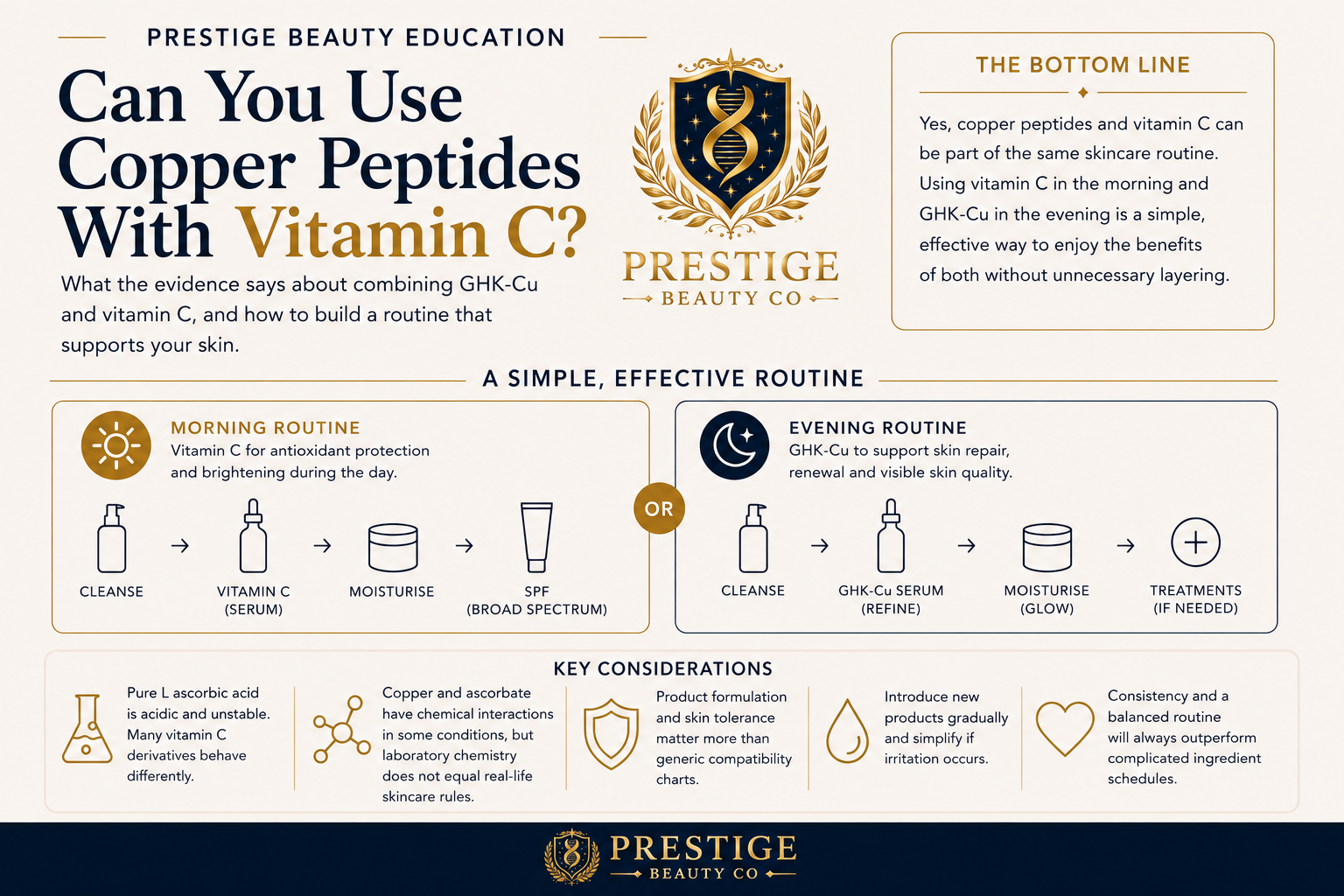
Morning
Cleanse
Vitamin C
Moisturiser
Broad spectrum SPF
Evening
Cleanse
GHK-Cu serum
Moisturiser
This removes most of the practical compatibility question without requiring you to abandon either ingredient.
Can you use GHK-Cu in the morning and vitamin C at night?
You could.
There is no universal law stating that vitamin C belongs exclusively in the morning and GHK-Cu exclusively at night.
However, vitamin C is commonly incorporated into daytime routines because of its antioxidant role.
A practical routine therefore often places vitamin C in the morning and GHK-Cu in the evening.
That arrangement is about simplicity.
It should not be interpreted as proof that the ingredients become dangerous or useless if their application times overlap.
Which should you apply first?
If you decide to use both products within the same routine, texture and individual product instructions matter.
A general skincare principle is to apply lighter formulations before richer ones.
But the names of the active ingredients alone cannot determine the correct order.
A lightweight GHK-Cu serum and a vitamin C cream would create one sequence.
A watery vitamin C serum and a richer peptide formulation could create another.
Follow the directions for the actual finished products.
What about vitamin C derivatives?
Vitamin C derivatives make blanket compatibility rules even less useful.
Several derivatives have been developed to improve stability or allow formulation under conditions different from those required by pure L ascorbic acid.
That means advice created specifically around an acidic L ascorbic acid serum should not automatically be applied to every product carrying the words “vitamin C” on its label.
The ingredient list matters.
The formulation matters.
And the particular vitamin C derivative matters.
Can sensitive skin use both?
Potentially, but introducing products gradually is sensible.
Low pH L ascorbic acid formulations can cause irritation in some people.
If you introduce GHK-Cu, vitamin C and several other active products simultaneously, it becomes difficult to identify what your skin does or does not tolerate.
Introduce products individually where possible.
If you experience persistent burning, redness, itching or irritation, simplify the routine.
More active ingredients do not automatically produce better skincare.
Where does REFINE fit?
REFINE occupies the lightweight serum stage of the Prestige routine.
If you already use a vitamin C serum in the morning, one simple option is to use REFINE during your evening routine.
For example:
Morning
Cleanse
Vitamin C
Moisturiser
SPF
Evening
Cleanse
REFINE
GLOW if required
This creates two straightforward routines without forcing several active products into the same application.
Can you use GLOW with vitamin C?
GLOW occupies the cream stage rather than the lightweight serum stage.
If your vitamin C product is a serum, a moisturising cream would normally follow the serum according to texture.
However, you should still consider the directions and formulation of the individual products you are using.
The presence of GHK-Cu in a product does not remove the need to think about the complete formulation.
Do you need to alternate days?
Not necessarily.
Separating vitamin C and GHK-Cu between morning and evening is already sufficient if your goal is simply to avoid layering them directly.
Alternating days is another option if you prefer an even simpler routine.
For example:
Day 1
Vitamin C routine
Day 2
GHK-Cu routine
There is no evidence based requirement to create a complicated rotation.
Choose whichever approach makes your routine easiest to use consistently.
What if you already use both together?
If your skin tolerates your existing routine well, there is no strong clinical evidence showing that you must immediately stop simply because a skincare compatibility chart says so.
At the same time, absence of evidence for a universal prohibition does not prove that every possible combination of products is chemically ideal.
Individual formulations differ enormously.
This is why product directions, formulation quality and skin tolerance remain important.
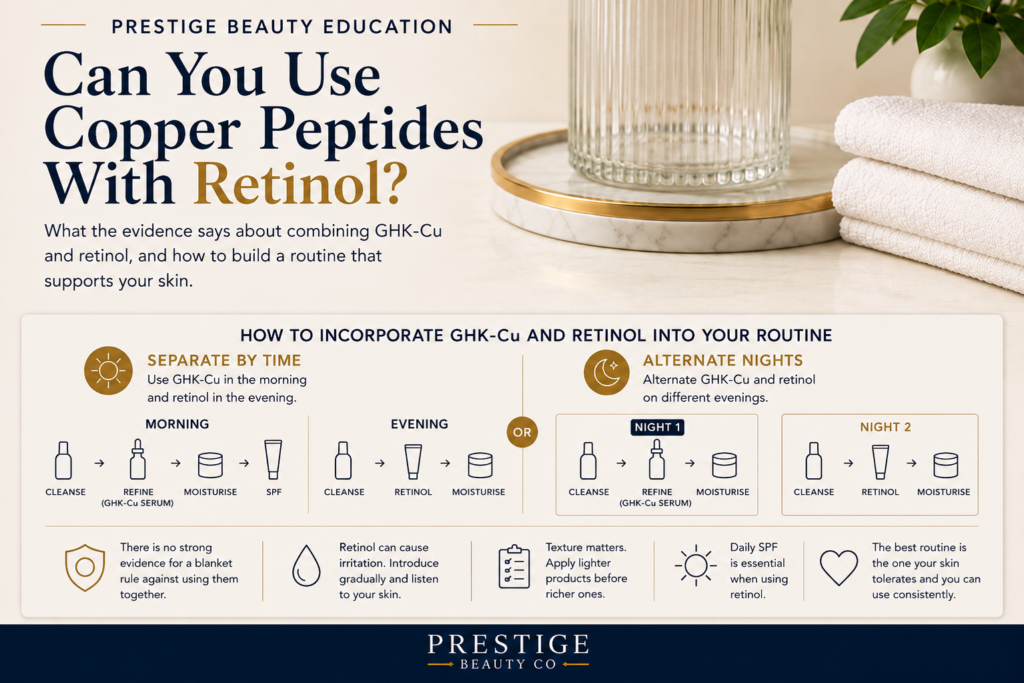
If retinol is also part of your routine, read Can You Use Copper Peptides With Retinol?
Is vitamin C better than GHK-Cu?
They should not really be treated as interchangeable ingredients.
Vitamin C has an established role as an antioxidant and has been investigated extensively in skin biology and topical skincare.
GHK-Cu is a copper binding peptide investigated for different biological processes associated with skin and extracellular matrix activity.
You can explore that research further in GHK-Cu in Skincare: What Does It Do?
Choosing between them is therefore not simply a question of deciding which ingredient is “stronger”.
They serve different formulation and skincare roles.
The simplest approach
If you want to use both and do not want to think about chemistry every morning, this is the easiest routine:
Morning
Cleanse
Vitamin C
Moisturise
SPF
Evening
Cleanse
REFINE
GLOW if required
That is simple, logical and easy to maintain.
You do not need a complicated ingredient timetable.
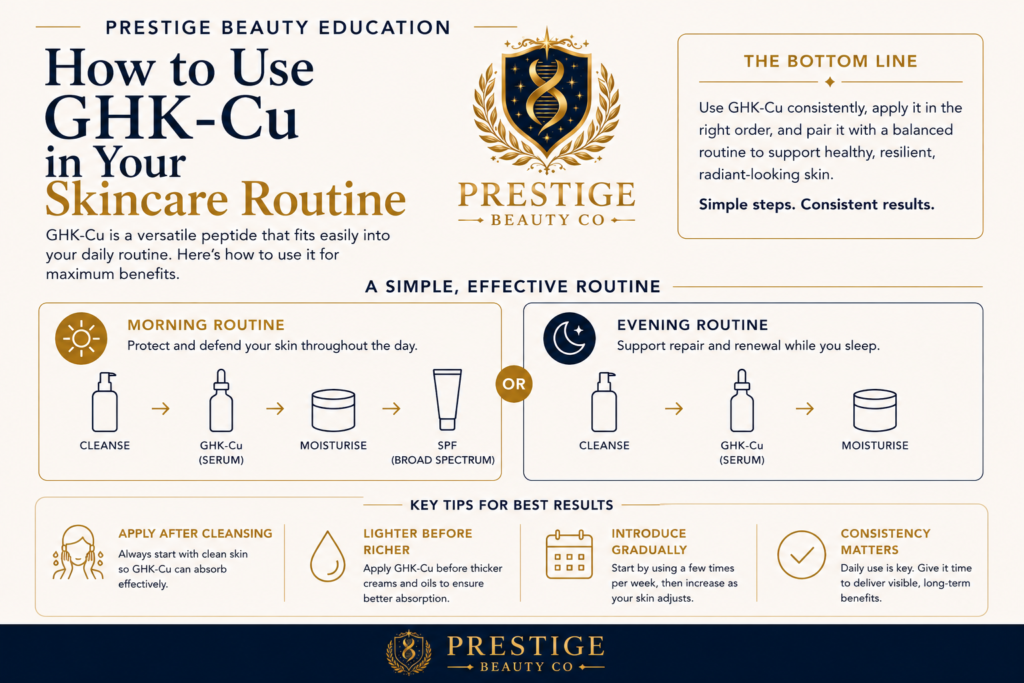
For a complete guide to product order, timing and layering, see How to Use GHK-Cu in Your Skincare Routine.
The bottom line
Yes, copper peptides and vitamin C can form part of the same skincare routine.
The popular claim that they must never be used together is more absolute than the available clinical evidence supports.
However, genuine formulation considerations exist.
Pure L ascorbic acid is unstable, commonly formulated at low pH and chemically different from many vitamin C derivatives. Copper and ascorbate chemistry also gives formulators legitimate reasons to consider stability carefully.
The simplest consumer approach is therefore not to panic about incompatibility.
If you want to use both ingredients, vitamin C in the morning and GHK-Cu in the evening creates an easy routine that avoids unnecessary layering.
Good skincare does not require every active ingredient to be applied at the same time.
The distinction about vitamin C forms is well supported. L ascorbic acid is particularly unstable and commonly requires a formulation below pH 3.5 for effective penetration, while derivatives such as magnesium ascorbyl phosphate can be stable under quite different conditions.