Peptides in skincare have become one of the most recognisable features of modern cosmetic formulations.
You will find them in serums, creams, eye products and increasingly sophisticated cosmetic formulations.
But the word peptide describes an enormous family of molecules.
Different peptides have different structures, proposed functions and levels of scientific evidence.
That means asking whether “peptides work” is a little like asking whether “vitamins work”.
The important question is which peptide, in which formulation, for what purpose?
What exactly is a peptide?
Peptides are short chains of amino acids.
Amino acids are the building blocks used to form proteins.
When amino acids join together through peptide bonds, they can form chains of different lengths and structures.
Shorter chains are generally described as peptides, while much larger and more complex chains form proteins.
The exact amino acid sequence matters because changing the sequence can produce a molecule with very different properties.
This is why two skincare ingredients can both be called peptides while having completely different proposed functions.
Why are peptides in skincare?
Peptides are interesting to cosmetic scientists because certain peptide sequences can interact with biological processes in highly specific ways.
Researchers have investigated different peptides in relation to processes involving:
• extracellular matrix components
• fibroblast activity
• collagen related pathways
• skin hydration
• pigmentation
• muscle contraction
• skin barrier function
• visible characteristics of ageing
But this does not mean every peptide performs all of these functions.
The effects associated with one peptide should not automatically be attributed to another.
Are there different types of skincare peptides?
Yes.
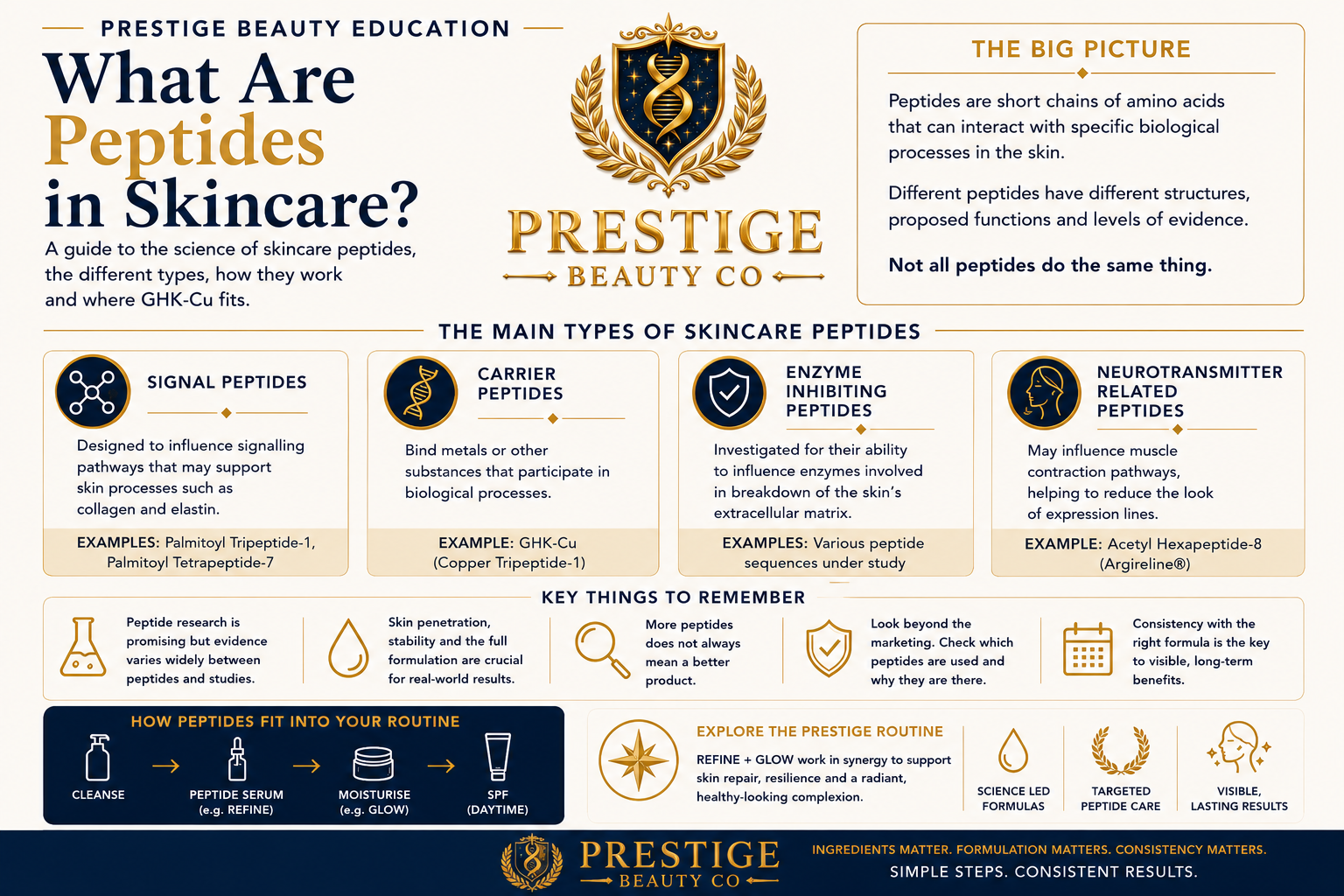
Skincare peptides are often grouped according to their proposed function.
The categories are useful for understanding peptide science, although the boundaries are not always perfect.
Signal peptides
Signal peptides are designed or selected because they may influence signalling pathways associated with processes in the skin.
Some have been investigated for their relationship with fibroblasts and extracellular matrix components.
Palmitoyl peptides are among the better known examples used in cosmetic formulations.
However, individual signal peptides need to be evaluated on their own evidence.
Being described as a signal peptide does not guarantee a visible cosmetic result.
Carrier peptides
Carrier peptides are associated with transporting or binding substances that participate in biological processes.
GHK-Cu is the most relevant example for our Education Hub.
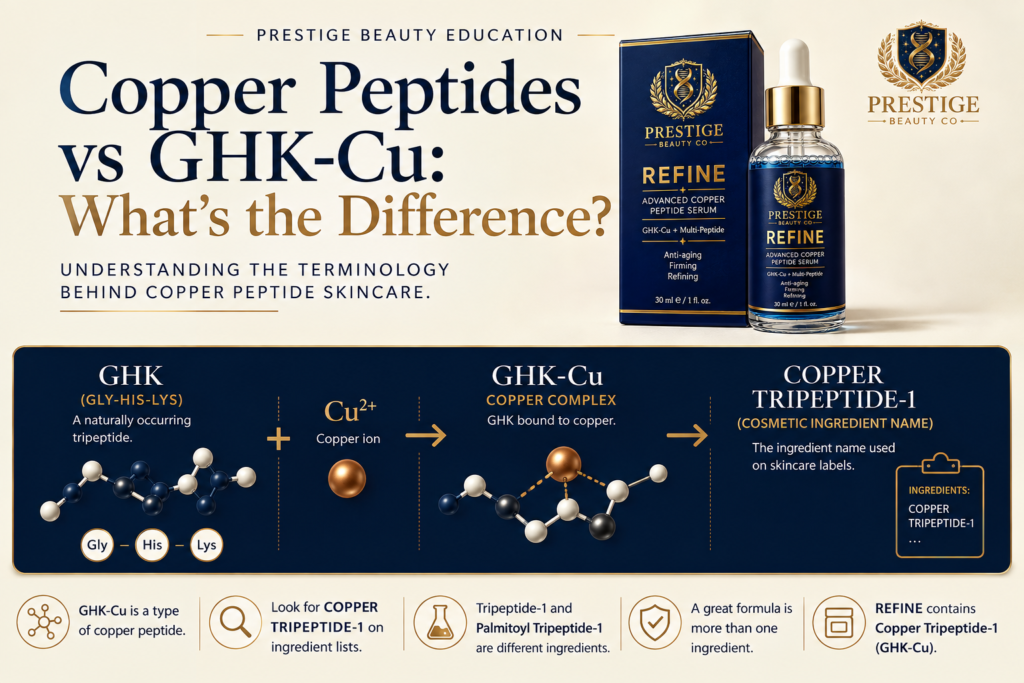
GHK is a naturally occurring tripeptide made from three amino acids:
glycine
histidine
lysine
When it binds copper, it forms the copper peptide complex known as GHK-Cu, or Copper Tripeptide-1 in cosmetic ingredient terminology.
GHK-Cu has been investigated for processes involving fibroblasts, extracellular matrix components and tissue remodelling.
This makes it very different from simply describing something as a generic “peptide”.
For a detailed introduction to this particular copper peptide, read What Is GHK-Cu?
What are neurotransmitter related peptides?
Another category includes peptides developed to influence pathways associated with muscle contraction.
One well known cosmetic example is Acetyl Hexapeptide-8, sometimes known by the trade name Argireline.
Its proposed cosmetic role is very different from GHK-Cu.
This illustrates why the word peptide alone tells you very little about what an ingredient is intended to do.
A copper binding tripeptide and a hexapeptide designed around neurotransmitter related mechanisms are both peptides, but they are not interchangeable ingredients.
What are enzyme inhibiting peptides?
Some peptides have been investigated for their ability to influence enzymes involved in processes such as extracellular matrix degradation.
Again, this represents another potential mechanism rather than a property shared by every peptide.
This is one reason skincare marketing claims such as “peptides boost collagen” are too broad.
Some specific peptides have evidence relating to collagen pathways.
That does not establish that every cosmetic peptide does the same thing.
Do peptides actually work in skincare?
This requires a more careful answer than most skincare marketing provides.
There is scientific evidence supporting biological activity for a number of individual peptides.
There are also clinical studies reporting improvements in visible skin characteristics from some peptide containing formulations.
However, the overall clinical evidence for topical peptides is still uneven.
Different studies use different peptides, concentrations, delivery systems, formulations and outcome measurements.
It is therefore difficult to treat all topical peptides as one scientifically proven category.
The evidence should be considered peptide by peptide and formulation by formulation.
What does the latest research say?
A 2026 systematic review and meta analysis examined randomised controlled trials involving peptide based approaches to skin ageing.
Nineteen trials involving 1,341 participants were included.
The researchers found improvements in some measures including hydration, brightness and wrinkles.
However, there is a very important detail.
Seventeen of the included studies investigated oral peptide formulations and only two investigated topical formulations.
The authors specifically noted that this imbalance limits conclusions about topical peptides.
That is exactly why we should be cautious when someone claims that the entire topical peptide category has overwhelming clinical proof.
The science is promising.
It is not uniform.
Why does skin penetration matter?
A peptide can demonstrate interesting activity in a laboratory and still face another challenge when placed into skincare.
It has to interact meaningfully with the skin.
The outermost layer of the skin, the stratum corneum, is an effective barrier.
Many peptides are relatively hydrophilic molecules, which can make penetration through this barrier difficult.
Researchers therefore investigate delivery systems, chemical modifications and formulation strategies designed to improve peptide stability and availability.
This means the finished cosmetic formulation matters enormously.
The ingredient name alone does not tell you everything.
Why are some peptides modified?
You may see peptide ingredient names beginning with terms such as:
Palmitoyl
Attaching a fatty component such as palmitic acid can change the physical properties of a peptide and may improve its interaction with the skin.
This is why ingredients such as palmitoyl peptides exist.
The modification is not simply there to make the ingredient name sound more scientific.
It can be part of the strategy used to improve delivery or stability.
What makes GHK-Cu different?
GHK-Cu is particularly interesting because it is not simply a synthetic sequence developed exclusively for cosmetics.
GHK occurs naturally in the human body and has a strong affinity for copper.
The copper complex has been investigated for several biological processes.
Research has associated GHK-Cu with fibroblast activity and components of the extracellular matrix, including collagen, elastin and glycosaminoglycans.
However, even with GHK-Cu, there are limitations in the published evidence.
Reviews of topical GHK have highlighted the relatively limited amount of clinical research and the importance of skin permeability and formulation.
That is why we describe GHK-Cu as an interesting and well studied peptide rather than pretending every proposed benefit has been conclusively demonstrated in large human cosmetic trials.
Are copper peptides the same as other peptides?
No.
Copper peptides are part of the wider peptide category.
GHK-Cu is one particular copper peptide complex.
Other cosmetic peptides may contain completely different amino acid sequences and have completely different proposed functions.
So:
GHK-Cu is a peptide.
But:
Not every peptide is GHK-Cu.
This distinction is important when comparing products.
You can read more in our guide Copper Peptides vs GHK-Cu: What’s the Difference?
Are more peptides always better?
No.
A product containing ten peptides is not automatically better than a product containing one or two carefully selected peptides.
Ingredient count is not a measurement of formulation quality.
What matters includes:
• which peptides are present
• their concentrations
• their stability
• the delivery system
• the complete formulation
• packaging
• compatibility with other ingredients
• whether meaningful evidence exists for those particular peptides
A long ingredient list can look impressive without telling you whether the finished product is effective.
What does “multi peptide” mean?
Multi peptide simply means that a formulation contains more than one peptide ingredient.
It does not describe one specific technology.
Two multi peptide products can therefore contain entirely different combinations of peptides.
This is another reason to look beyond the words printed prominently on the front of a product.
The ingredient list tells you which peptides are actually present.
Are peptides an alternative to retinol?
Not automatically.
Retinoids and peptides are completely different ingredient categories.
Retinoids have a substantial body of clinical research behind their use for visible signs of photoageing.
Individual peptides may have evidence supporting particular cosmetic applications, but the evidence varies considerably between peptide ingredients.
Calling peptides a universal “retinol alternative” oversimplifies the science.
Someone may choose a peptide focused routine because they prefer it or because it suits their skin.
That does not make every peptide scientifically equivalent to a retinoid.
If retinol already forms part of your routine, our guide Can You Use Copper Peptides With Retinol? looks specifically at how the two can fit together.
Can peptides be used every day?
Many cosmetic peptide products are designed for regular daily use.
However, the directions for the finished product should always take priority.
A peptide serum may contain many other ingredients besides the peptide itself.
Your skin is exposed to the complete formulation, not an isolated ingredient name.
If you are introducing a new product, gradual introduction is sensible, particularly if your routine already contains several active ingredients.
Can peptides be used morning and night?
Depending on the finished formulation, yes.
Peptides are commonly incorporated into both morning and evening skincare routines.
A straightforward routine might look like:
Morning
Cleanse
Peptide serum
Moisturiser
Broad spectrum SPF
Evening
Cleanse
Peptide serum
Moisturiser
You do not need an elaborate routine simply because the ingredient itself has complicated chemistry.
For more practical guidance on product order and timing, see How to Use GHK-Cu in Your Skincare Routine.
If vitamin C is also part of your routine, our guide Can You Use Copper Peptides With Vitamin C? looks specifically at that combination.
Where do REFINE and GLOW fit?
REFINE occupies the lightweight serum stage of the Prestige routine.
GLOW occupies the cream stage.
Used together, the order is straightforward:
Cleanse → REFINE → GLOW
During the daytime, broad spectrum SPF would follow.
This gives each product a clear role rather than creating a routine containing numerous overlapping products simply because they all advertise peptides.
How should you choose a peptide product?
Start by ignoring the size of the peptide claim on the front of the packaging.
Look instead at what the product actually contains.
Ask:
Which peptides are present?
What is known about those particular peptides?
What other ingredients support the formulation?
Does the product suit the role you need it to perform?
Is the company making realistic cosmetic claims?
And perhaps most importantly:
Will you actually use it consistently?
A scientifically interesting ingredient cannot help your skincare routine if the product is unpleasant or unnecessarily complicated to use.
Are peptides just a skincare trend?
Peptides are certainly fashionable, but peptide research itself is not simply a social media trend.
Specific peptides have been investigated scientifically for decades.
What has changed is consumer awareness.
The skincare market increasingly uses peptide terminology as a selling point.
That creates both opportunity and confusion.
The opportunity is that increasingly sophisticated ingredients are becoming available in everyday cosmetics.
The confusion comes when the word “peptide” is treated as though it represents one ingredient with one universally proven effect.
It does not.
The bottom line
Peptides are short chains of amino acids, and they represent a large and diverse family of ingredients used in modern skincare.
Different peptides may function in very different ways.
Signal peptides, carrier peptides and neurotransmitter related peptides should not be treated as interchangeable simply because they share the peptide label.
Some individual peptides have interesting laboratory research and clinical evidence.
At the same time, topical delivery can be challenging and the clinical evidence across the entire peptide category remains inconsistent.
GHK-Cu is one particularly interesting example within this wider field.
Understanding that distinction makes peptide skincare much easier to evaluate.
Do not ask simply whether a product contains peptides.
Ask which peptides it contains, why they are there, and what evidence supports them.